


Anatomy of a VIP Upgrade Crypto Scam
In cybercrime, sophistication isn’t always technical — it’s psychological.
We’ve recently investigated a campaign that exemplifies this. It blends a polished crypto dashboard, a fabricated technical restriction, and a carefully staged escalation designed to extract increasingly large payments from victims.
At its core, this is a modern evolution of the classic advance-fee scam — repackaged for the crypto era.
Act I: The Illusion of Profit
Victims are provided login credentials to access what appears to be a legitimate trading platform. Once inside, they are greeted with a convincing interface — and a massive balance, often in the hundreds of thousands of USDT.


The attack begins with a familiar lure: promises of extreme returns, such as “Earn up to 20% daily profit on USDT.”
Everything is designed to feel real:
- Account dashboards
- Deposit and withdrawal options
- Transaction histories
At this stage, the attacker has already achieved the primary objective: establish belief.

Act II: The Barrier
The moment the victim attempts to withdraw funds, the illusion breaks.
The platform requests a “KEY” (“CLAVE” in this case) — a required credential that the user supposedly created during registration. Without it, withdrawals are blocked.

Support channels reinforce the narrative:
- The KEY cannot be recovered
- The account cannot be reset
- Funds are effectively locked
Then comes the pivot.
Victims are told the only solution is to:
Create a new account
Upgrade it to VIP status
Transfer funds internally (which allegedly bypasses the KEY restriction)
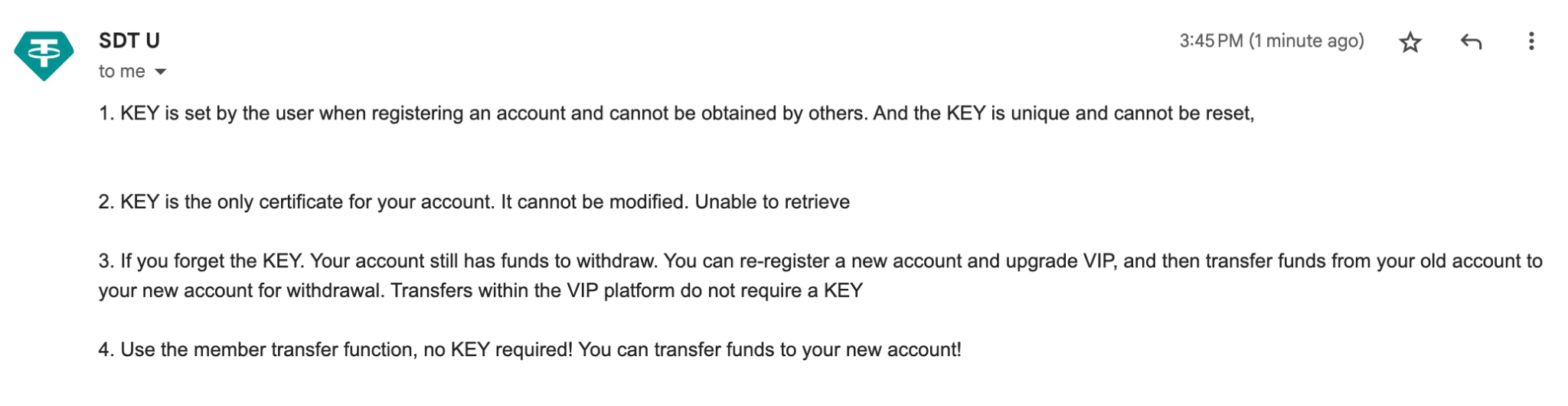
This transforms the victim from a passive target into an active participant in the scheme.

Act III: The Extraction
The “VIP upgrade” introduces the real objective: payment.

Victims are presented with tiered levels requiring deposits such as:
- 50 USDT (entry level)
- 1,000 USDT
- 3,000 USDT
- Up to 50,000 USDT for full functionality
The justification is simple: upgrading unlocks the ability to transfer or withdraw the trapped funds.
The logic appears compelling — especially when compared to the large balance displayed on the account.
This is the trap. But it is tempting

The Mechanics of Deception
This campaign aligns precisely with the definition of an advance-fee scam:
A victim is persuaded to pay upfront for a promised reward that never materializes.
Here, the promised reward is the large crypto balance. The upfront payment is the VIP upgrade.
A critical psychological driver is the sunk cost fallacy:
Victims perceive the displayed balance as real and rationalize additional payments as necessary steps to recover it.
In reality, the balance is fictitious — controlled entirely by the attacker.
Key Red Flags
Several indicators clearly expose the fraudulent nature of this operation:
Fabricated Technical Constraints
Legitimate platforms provide recovery mechanisms. Permanent fund lockouts due to a missing “KEY” are not standard practice.Unprofessional Support Channels
Use of free email services (e.g., Gmail) instead of official support infrastructure.Cross-Region Targeting
Inconsistent indicators — such as mismatched phone numbers, domains, and language localization — suggest mass targeting across regions.Unrealistic Returns
Claims like “20% daily profit” are inherently unsustainable and commonly used to filter high-risk victims.Final Learnings
This VIP upgrade scam demonstrates that the most effective cybercrime is often built on psychology, not complex technology. The attackers skillfully exploit human biases — the allure of impossible profits and the pressure of the sunk cost fallacy — to convince victims to invest real money for an illusory reward.
The core lesson is this: Never pay an “upfront fee” to access funds already promised to you. Legitimate financial platforms will never permanently lock your funds over a missing, unrecoverable key or demand a significant upgrade payment to restore basic functionality.
Protect Yourself:
- Verify Everything: Treat unrealistic profit promises (like “20% daily profit”) as immediate red flags. Independently verify platform legitimacy using official channels, not the site’s built-in support.
- Recognize the Trap: If you’re being asked to make a new deposit to recover existing funds, you are being targeted with an advance-fee scam. Stop the transaction immediately.
To protect your brand and users from this kind of sophisticated, high-speed scam, you need a proactive, industry-leading defense. PhishFort specializes in dismantling phishing campaigns, fraudulent domains, and rogue applications across the ecosystem with an industry-best takedown success rate of 99.8%.


