

In the hyper-connected landscape of 2026, your brand is more than just a logo or a name — it is a digital promise of security and trust. However, as the digital ecosystem expands, so does the sophistication of those looking to exploit it. The rise of generative AI and automated fraud networks has turned brand impersonation into a high-speed arms race.
Today, relying on manual monitoring or reactive security measures is no longer a viable posture. To maintain customer loyalty and protect your bottom line, implementing enterprise-grade brand protection tools has transitioned from a luxury to a corporate necessity.
Traditional security perimeters end at your internal firewall. Yet, your brand lives in the wild: on social media, across third-party app stores, within decentralized Web3 protocols, and in the dark corners of the web. Modern brand protection is about moving beyond “detection” to a state of permanent “disruption.”
Why 2026 Demands a New Class of Brand Protection
The correlation between brand consistency and consumer trust is absolute. However, the threat landscape has shifted fundamentally in the last 24 months. According to recent cybersecurity outlooks, external, identity-driven, and AI-enabled threats now dominate the global risk agenda.
The Rise of AI-Powered Impersonation
Bad actors no longer need technical brilliance to launch a global phishing campaign. Generative AI allows them to mirror your brand voice, replicate your UI/UX with pixel-perfect accuracy, and even create deepfake video content for executive impersonation. These attacks are high-fidelity and high-frequency.
The Weaponization Gap
In 2026, the “window of vulnerability” has shrunk. A malicious actor can register a typosquatted domain, deploy a phishing kit, and harvest thousands of credentials within sixty minutes. If your brand protection tools don’t operate in real-time, you aren’t protecting your brand; you’re just documenting its demise.
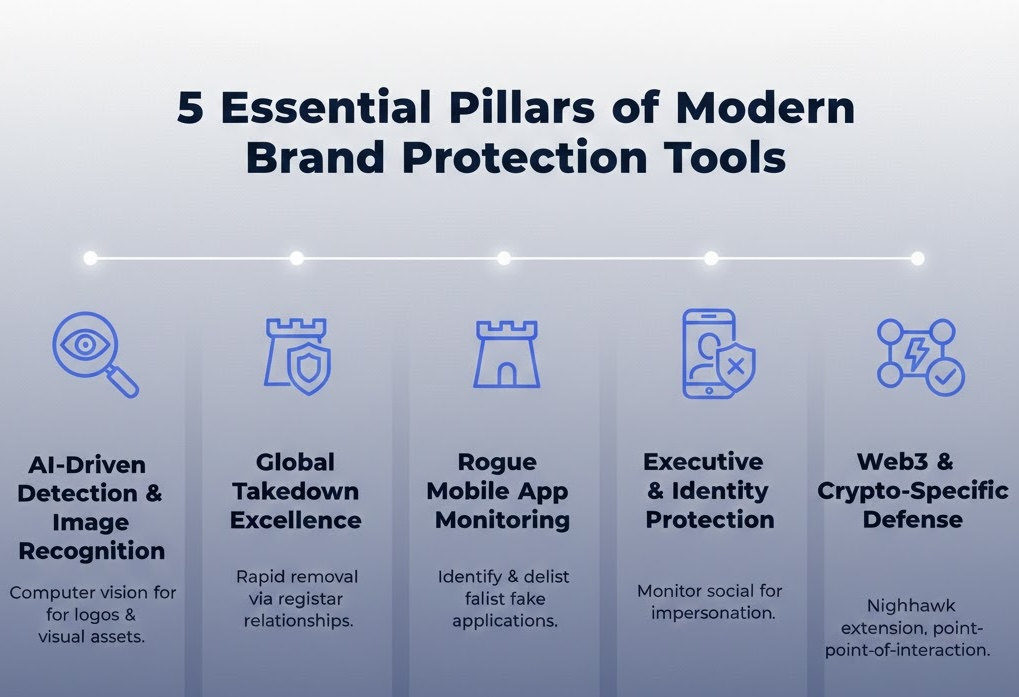
5 Essential Pillars of Modern Brand Protection Tools
When evaluating a solution to safeguard your digital footprint, the criteria must go beyond simple keyword alerts. An elite toolset must provide a 360-degree view of your external risk.
AI-Driven Detection and Image Recognition: Basic text-based scanning is easily bypassed. Modern tools must employ computer vision to identify unauthorized use of your logo or visual assets, detecting “brand-jacking” even when it is hidden in images or videos.
Global Takedown Excellence: Detection without enforcement is merely a notification of loss. We leverage deep, long-standing relationships with registrars and the global abuse community to remove malicious content in record time through our Takedown Service .
Rogue Mobile App Monitoring: Attackers increasingly rely on fake apps to bypass browser-based security. Continuous monitoring ensures these applications are identified and delisted from stores before they reach your customers’ devices.
Executive and Identity Protection: Your leadership team is a primary target. Modern tools must monitor for executive impersonation across social platforms to prevent “CEO fraud.”
Web3 and Crypto-Specific Defense: For organizations in the blockchain space, the risks are exponentially higher. PhishFort’s Nighthawk extension protects millions of users by identifying threats at the point of interaction.
Deep Intelligence: Dark Web Visibility and Predictive Protection
True authority in brand protection in 2026 is defined by what you see before it reaches the surface. High-performance brand protection tools must integrate comprehensive Dark Web monitoring .
Often, before a phishing campaign is even launched, the “blueprints” — leaked customer databases, employee credentials, or specific brand assets — are traded in underground forums and encrypted Telegram channels. By maintaining a constant presence in these dark corners, PhishFort provides an anticipatory layer of intelligence. We don’t just wait for a fake site to appear; we identify the intent and the stolen data that fuels the attack, allowing for defensive measures like credential resets and proactive blocking before the first customer is targeted.
The Network Effect: Moving from Takedowns to Community Immunization
In a landscape where threats scale exponentially, a siloed defense is a weak defense. At PhishFort, we utilize a “Network Effect” strategy to turn individual attacks into collective immunity.
Every time our tools identify and neutralize a threat, the data — including malicious URLs, IP addresses, and behavioral patterns — is instantly fed into our global Blocklist. This blocklist currently protects over 418 million users worldwide through integrations with top-tier crypto wallets, browsers, and security providers. By choosing a brand protection partner that prioritizes community intelligence, you aren’t just shielding your own assets; you are contributing to, and benefiting from, a global immune system that makes the entire internet hostile for fraudsters.
The PhishFort Difference: Proactive Heroism in Action
At PhishFort, we don’t just “alert” you to problems; we act as your frontline defenders. We operate with the belief that a secure internet is a collaborative effort.
When you integrate PhishFort’s Brand Protection Platform, you aren’t just buying software. You are gaining a team that understands the nuance of the threat landscape. We specialize in the “hard” takedowns — the ones that require more than just an automated email — navigating international jurisdictions to ensure your brand remains untarnished.
To summarize:
What are the best brand protection tools for 2026?
The best tools are those that offer a combination of AI-powered detection, automated monitoring, and — most importantly — rapid, human-led takedown capabilities. While many tools can “see” a threat, PhishFort is unique in its ability to “stop” the threat through its extensive global network.
How do brand protection tools handle AI-generated deepfakes?
Advanced platforms use adversarial AI to analyze pixel inconsistencies and metadata that indicate a deepfake. By monitoring for sudden spikes in engagement or unusual patterns on social channels, these tools can flag potential deepfake impersonations for immediate removal.
What are the key features, pricing, pros, and cons of brand protection tools?
Key Features: Automated 24/7 AI detection, real-time takedowns, dark web monitoring, and cross-platform visibility (social media, apps, Web3).
Pricing: Most enterprise tools use a tiered subscription model based on the number of monitored assets (domains, social profiles). Prices range from mid-market affordable to high-tier enterprise, often requiring a custom quote for full DRP services.
Pros: Immediate reduction in fraud-related losses, protection of customer trust, and automated legal enforcement (DMCA/Trademark).
Cons: Higher-end tools can be a significant investment; some automated platforms generate false positives if not tuned by human experts like those at PhishFort.
Turning the Tide Against Brand Abuse
In 2026, silence is not an option. Every hour a fraudulent site remains live erodes your brand equity. Being reactive in this environment is the same as being unprotected.
Your brand deserves a defender that is proactive, authoritative, and relentless. By leveraging specialized brand protection tools, you not only protect your revenue but also safeguard the trust your customers have placed in you.
Don’t wait for the next incident to take action. Explore PhishFort today and see how we can shield your community from emerging threats.


