

As organizations move toward 2026, the cybersecurity threat landscape continues to expand beyond traditional network boundaries. Digital risk protection has become a critical discipline for identifying and mitigating threats that originate outside the corporate perimeter, including brand impersonation, phishing, identity abuse, and data exposure across the open and dark web.
Independent research from global institutions shows that external, identity-driven, and AI-enabled threats will dominate the cyber agenda in the coming years, forcing security teams to rethink how digital risk is monitored and managed.
1. AI-Driven Threats Are Redefining Digital Risk Protection
Artificial intelligence is accelerating both cybercrime and cyber defense. Threat actors are increasingly using generative AI to automate phishing campaigns, create highly convincing social engineering messages, and generate deepfake content that impersonates real individuals or brands. At the same time, defenders are deploying AI-based analytics to detect anomalies at scale.
This creates an arms race in which digital risk protection must evolve to detect not only known indicators of compromise but also subtle AI-generated impersonation attempts across external channels.
2. Speed and Scale of External Attacks Will Increase
By 2026, cyber threats are expected to operate at unprecedented speed and scale. Automation enables attackers to launch thousands of phishing domains, fraudulent ads, and impersonation accounts within hours. Many of these attacks target customers and partners rather than internal infrastructure.
Industry analysis highlights that identity abuse and brand exploitation are becoming preferred entry points because they bypass traditional perimeter defenses and exploit trust instead of vulnerabilities.
3. Identity Becomes the Primary Attack Surface
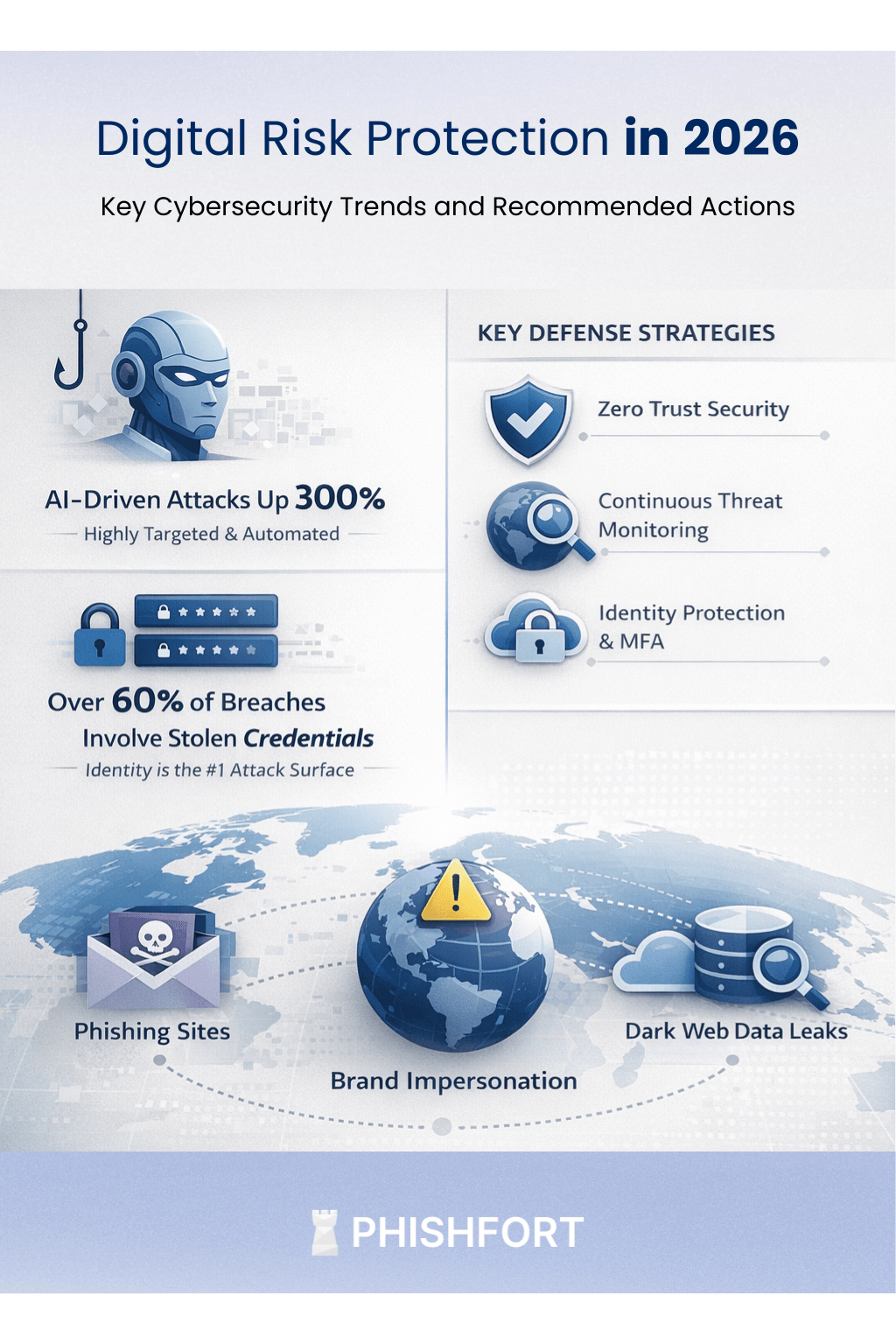
Identity is increasingly viewed as the most valuable asset for attackers. Stolen credentials, session tokens, and impersonated digital identities enable fraud, account takeover, and lateral movement without exploiting technical vulnerabilities.
Digital risk protection in 2026 must therefore extend to monitoring leaked credentials, executive or employee impersonation, and the abuse of trusted identities across public platforms and third-party services.
Identity has become the new perimeter, and attackers are focusing on credentials and digital trust rather than exploiting systems.
4. External Attack Surface Management Converges with DRP
The distinction between External Attack Surface Management (EASM) and digital risk protection is narrowing. Organizations are recognizing that discovering internet-facing assets, domains, subdomains, and cloud services is foundational to detecting brand abuse and fraud.
By 2026, best practice points toward continuous asset discovery combined with threat intelligence and response workflows, rather than static or periodic assessments.
5. Quantum and Cryptographic Readiness Enter Risk Planning
Although large-scale quantum attacks are not yet widespread, organizations are beginning to plan for cryptographic disruption. Public-facing assets, certificates, and encryption methods are being reviewed for long-term resilience.
Digital risk protection programs are expected to incorporate cryptographic hygiene and visibility into exposed services as part of broader risk assessments.
6. Zero Trust Matures Into an Operational Standard
Zero Trust principles are moving from theory into daily operations. Continuous verification, least-privilege access, and identity-centric controls are becoming standard security expectations rather than aspirational goals.
From a digital risk protection perspective, Zero Trust reinforces the need to monitor identity abuse externally and ensure exposed credentials or impersonation attempts cannot be used to gain access.
7. Regulatory Pressure Drives External Risk Visibility
Governments and regulators are increasingly focusing on operational resilience, cyber risk disclosure, and third-party exposure. External digital threats, including phishing campaigns and data leaks, are now viewed as governance issues rather than purely technical incidents.
As a result, digital risk protection data is being used to support compliance, reporting, and executive decision-making.
Cyber risks are increasingly driven by identity-based attacks and social engineering, exploiting trust rather than technical vulnerabilities.
Source: Global Cybersecurity Outlook 2026 | World Economic Forum
Recommended Digital Risk Protection Measures for 2026
Based on these trends, organizations should prioritize the following actions:
- Continuous monitoring of brand abuse, phishing domains, fake social media accounts, and malicious ads
- Identity-focused risk detection, including credential exposure and impersonation attempts
- Integration of digital risk protection with broader exposure management and incident response
- Clear governance around AI usage to reduce data leakage and misuse
- Improved visibility into third-party and supply chain digital exposure
Last thoughts
By 2026, digital risk protection is no longer a niche capability. It is a foundational component of modern cybersecurity strategy, focused on defending trust, identity, and brand presence across an increasingly hostile digital ecosystem. Organizations that invest early in external visibility, identity resilience, and rapid response will be best positioned to reduce fraud, reputational damage, and business disruption.
If your organization is preparing for the evolving threat landscape of 2026, now is the time to strengthen your external defenses. Digital risk protection is what helps you identify brand abuse, phishing, identity threats, and exposure across the open web before they turn into real incidents.